
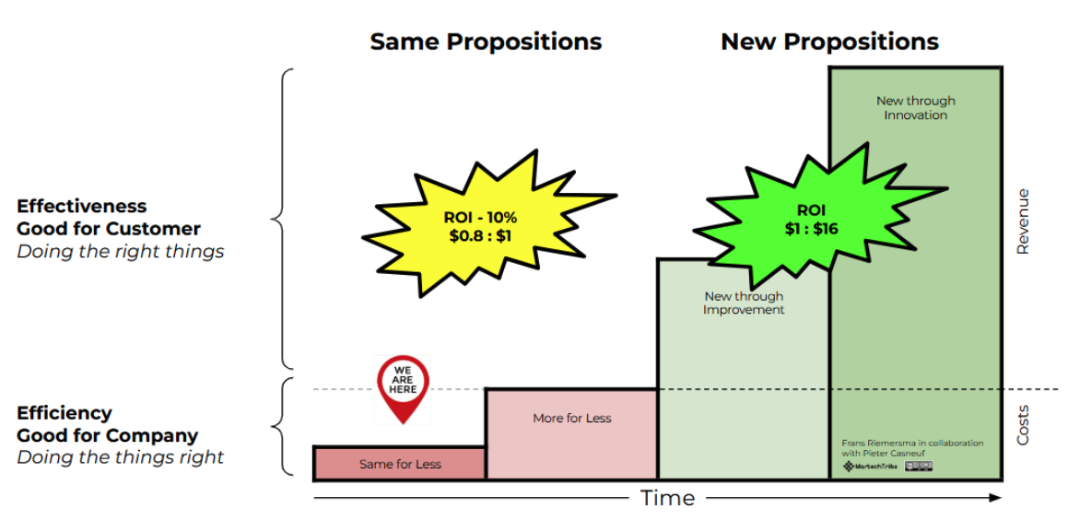
Every company wants ROI from AI, but the real question is where that return will come from. Efficiency wins are easy to spot — reduced costs, faster outputs, leaner teams — yet these gains tell only a fraction of the story. If we study how progress has unfolded in past technological eras, a more useful pattern emerges. Technologies do not create their real value through automation alone. They create it through reinvention.
Understanding this pattern matters now. It shows us not only where AI is today, but where it is heading next. The companies that recognise this curve early will avoid getting stuck in incremental improvements and instead position themselves for the leap into entirely new propositions and markets.
To see that future more clearly, we need to examine how progress typically unfolds — from invention, to adoption, to transformation.
The Pattern of Progress
Progress rarely moves in a straight line. It begins with an invention, a new capability that shifts what is possible. Cars, airplanes, computers, transistors, and large language models all created new outcomes before anyone knew how to use them well. At the moment of invention, nothing is optimized. The technology is pure potential, and society has no established way to turn that potential into value.
Once the capability exists, the adoption curve begins. Industries learn how to apply the invention, shape it, and scale it, and this journey tends to follow a predictable pattern across eras:
- Same for Less. Use the invention to do an existing task faster or cheaper.
- More for Less. Scale the same task with better performance and lower cost.
- New Through Improvement. Create a new kind of product or service that the invention makes possible.
- New Through Innovation. Build entirely new markets and ecosystems on top of the capability.
The invention opens the horizon. These four stages describe how industries learn to walk into it.
The Progress Pattern: From Saving to Creating
Once we understand how progress unfolds, the next question is how value emerges along that curve. Not every stage creates value in the same way. The first two stages focus on efficiency — doing existing work with fewer resources. The latter two focus on effectiveness — creating new outcomes that did not exist before.
This distinction sits at the heart of every technological transition. Efficiency improves the current system. Effectiveness improves the result. Efficiency is subtractive and bounded, reducing cost and effort. Effectiveness is additive and unbounded, opening new opportunities and new forms of value.
A simple way to see the difference:
Efficiency focuses on the company, while effectiveness focuses on the customer. When a company saves time producing a product, that is efficiency because it is “doing things right”. When a company saves time for the customer in using the product, that is effectiveness because it is “doing the right things”.
Efficiency is important, but it eventually plateaus. It makes you faster, not fundamentally different. Effectiveness, by contrast, compounds. It reshapes what a business can offer and how it competes. This is the hinge for understanding AI: the real returns show up only when companies move beyond doing the same things better and start doing better things altogether.
Where AI Agents Fit in the Journey
You can slice agentic AI by model type, reasoning depth, or latency. That is useful for architects, but less helpful for people running a Martech stack. Practically, agents are tools that serve people, so the more important question is simple: who does the agent work for, and who benefits from its actions?
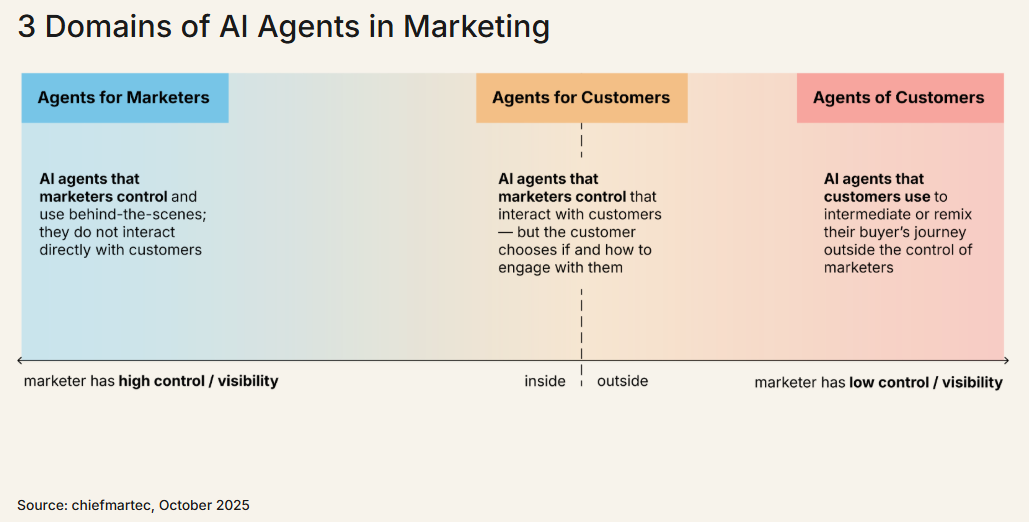
Three domains emerge.
- Agents for Marketers. These agents work behind the scenes. Marketers control them, configure them, and decide where they operate. They automate workflows, enrich data, and orchestrate tasks, but customers never interact with them directly.
- Agents for Customers. These agents are deployed by marketers but chosen by customers. They appear in websites, apps, and service channels, and customers decide if and how they engage with them. They become visible parts of the experience.
- Agents of Customers. These agents represent the next shift. They are tools customers bring with them — software acting on their behalf, outside the marketer’s control. Discovery, evaluation, and negotiation begin to happen agent-to-agent, and brand visibility depends on being understandable and selectable by these systems.
Once you see these three types, the relationship with the adoption curve becomes clear. Agent types and adoption stages show overlap. Some agents only emerge once the industry reaches the right level of maturity. The internal agents of early efficiency are not the same agents that create new experiences, and they are not the agents that eventually reshape markets.
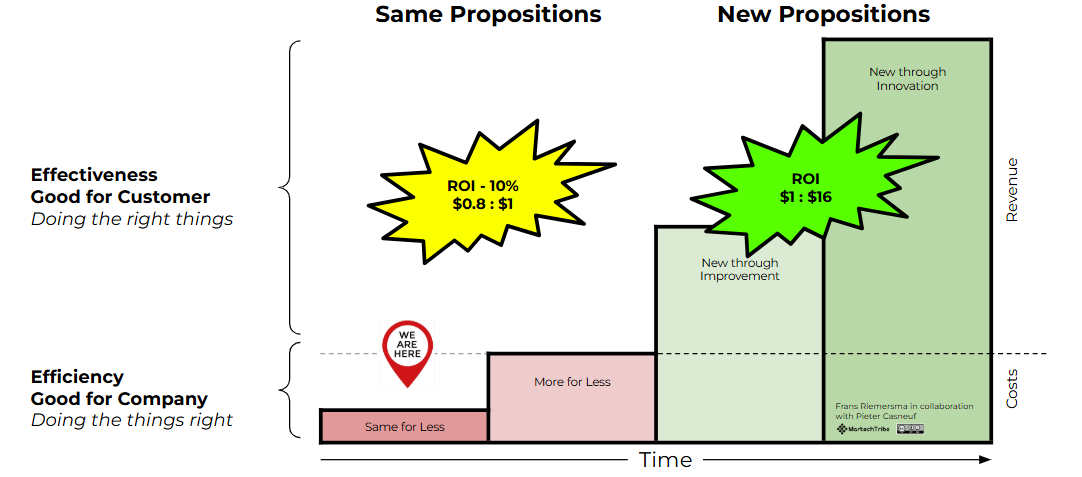
Same for Less – Agents for Marketers. In the early stages, agents sit inside the company. They automate tasks like tagging content, processing requests, or preparing reports. These agents increase speed and reduce cost, but they do not change the experience or the model. They improve the system, not the outcome.
More for Less – Agents for Marketers at Scale. As capabilities grow, these agents scale. They drive more campaigns, handle more data, and support more operational load. The business moves faster, but it still works the same way. Efficiency compounds, but nothing new is created.
New Through Improvement – Agents for Customers. Here the shift begins. Agents become part of the product or service itself. They guide choices, answer questions, and adapt content to context. These agents still belong to the company, but customers interact with them directly. This creates new forms of value, and revenue starts to reflect it.
New Through Innovation – Agents of Customers. In the final stage, customers bring their own agents. These agents evaluate, compare, negotiate, and filter on their behalf. Markets reorganise around intent expressed through software, and brands must be clear, accessible, and compelling to systems acting on the customer's behalf. This is the true frontier, where AI reshapes not only operations or experiences, but the market itself.
This is how AI agents evolve along the journey — from internal helpers, to experience partners, to independent actors that redefine how demand and supply meet.
The Leap Beyond Efficiency
If you follow the news feeds, most AI stories still live in the first two stages: automating tasks, reducing headcount, and squeezing more out of existing workflows. These moves create efficiency, but not an advantage. Very few headlines focus on net-new propositions, yet that is where AI’s real frontier opens.
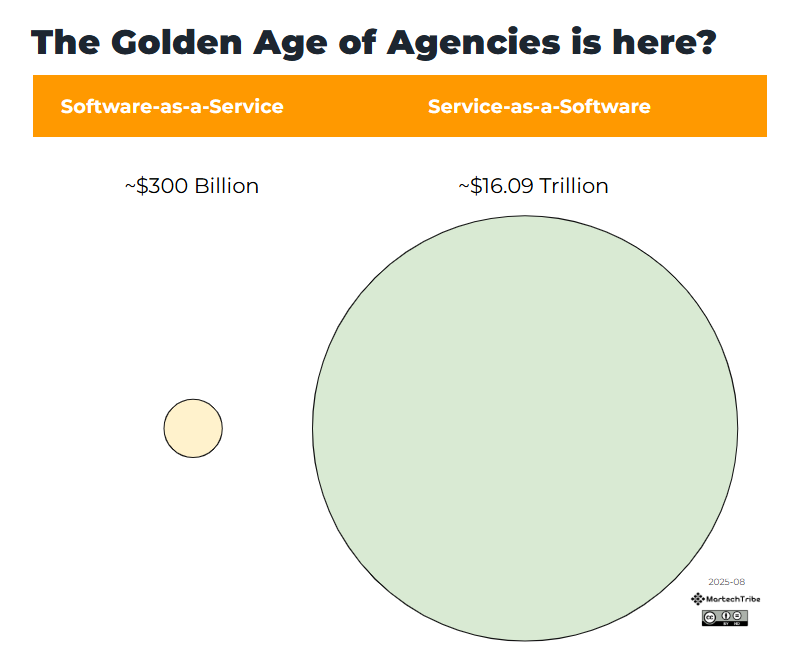
Entire categories such as Service-as-a-Software remain largely unexplored. Here, services become productized and delivered autonomously, creating value that is not possible in today’s operating models. This is the shift from internal productivity to external differentiation.
AI doesn’t just make teams faster. It can make brands feel closer. It turns signals into empathy, intent into timing, and content into conversation. Imagine every customer feeling genuinely understood and served — not by algorithms, but through them. This is effectiveness in action, and it sits in the top half of the adoption curve.
Here is how to begin that leap:
- Map your AI initiatives. Which ones only drive efficiency, and which expand or redefine customer value?
- Run a pilot that reimagines a relationship, not a workflow. Start with one moment where AI could improve the experience, not the process.
- Ask: If customers loved how we engaged them, what would we build next?
The transformation starts when AI stops saving time and starts creating connections — when it shifts from helping you do things better to helping you do better things.

Related posts
Keep reading for more marketing technology information!
Service-as-a-Software: Scale Services Like Software with AI
Value Engineering 101. Why, What, and How?
The Real Value of AI: From Faster Horses to New Economies