
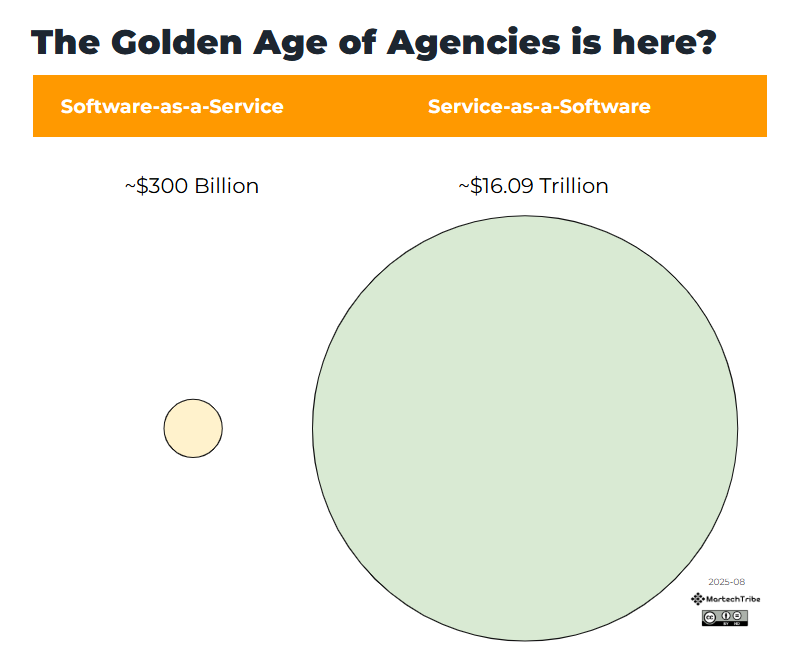
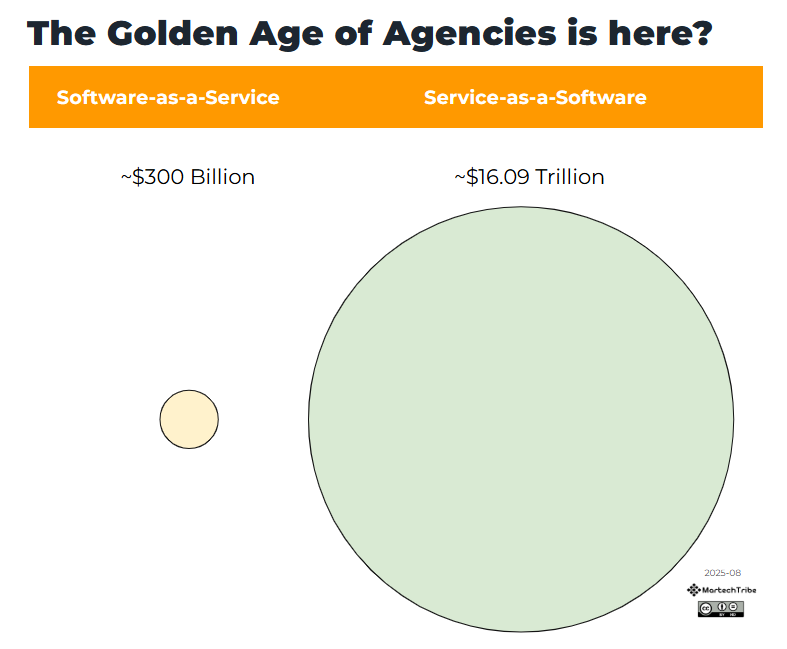
The services economy is enormous, more than $16 trillion, over 50x the size of SaaS. Yet it has never been able to scale like software. Not because the expertise wasn’t there, but because people don’t scale. Agencies, consultancies, and professional services firms have always grown by adding more talent, trading hours for outcomes, and absorbing the complexity that comes with headcount.
Even firms with beautifully documented methods couldn’t escape the constraint. Knowledge was standardized, but delivery wasn’t. And that is precisely the limitation AI removes.
LLMs feed on structured knowledge. They don’t replicate labor — they replicate expertise. For the first time, what makes a service business valuable can be encoded, automated, and delivered at scale. AI isn’t making services faster; it’s making them scalable.
This is the breakthrough: services can now scale like software, not by hiring more people, but by productizing the expertise those people hold. And the firms that grasp this shift will enter a new era — one where the largest economy in business finally gains the economics of software.
The Golden Age for Agencies?
Software-as-a-Service automated workflows. Service-as-a-Software automates expertise. That shift is profound. It means an agency can take its playbook — decades of proven methods, frameworks, and domain knowledge — and turn it into an AI-powered system that delivers outcomes without needing to add people. Instead of scaling through headcount, agencies can scale through encoded expertise.
Work moves from human execution to human orchestration. Experts no longer repeat the same processes; they design the systems that perform them. Agencies with well-documented, standardized knowledge stand to benefit most because AI can directly consume and operationalize what they already know.
The opportunity isn’t just operational — it’s economic. When agencies package their expertise into repeatable, AI-driven systems, margins shift from traditional 10–20% service levels toward software-like economics of 60–80%. They stop selling hours and start selling outcomes that scale.
In this model, the next breakthrough platforms may not come from classic SaaS companies, but from service firms that learn to productize their intellectual property. AI enables service businesses to behave like software businesses, unlocking a golden age not because of new tools, but because the expertise they’ve always had can finally scale.
When technological inventions drive business innovation
Technological inventions are often confused with business innovation. Those are two very different things.
When new technological inventions emerge, humans rarely grasp their full potential at first. We tend to treat them as extensions of what already exists, rather than as catalysts for entirely new possibilities.
The horseless carriage is the classic example: the first cars were seen as faster horses. Only once the Model T became a commodity did the real business innovations appear — highways and bridges, oil refineries, roadside restaurants, motels, tourist guides. These were net new industries, not improvements of the old existing businesses.
We are doing the same today with AI. Early use cases frame AI as a faster or cheaper version of current processes — a productivity booster, not a business model transformation.
This is why the AI Value Framework is critical. AI, as an invention, commoditizes the production of software, but business innovation takes time to catch up. Most organizations are still in the “faster horse” phase, applying AI to do what they already do, just more efficiently. But efficiency is only the first step.
- Efficiency focuses on the procedure
serving the customer indirectly and the company directly. - Effectiveness focuses on the outcome
serving the customer directly and the company indirectly.
A hospital may say, “The operation was successful,” but if the patient died, the procedure was efficient, but the outcome did not benefit the patient. It’s a reminder that efficiency’s focus is not to create value — it simply makes things less bad. The true net new value emerges from effectiveness: improving the result for the customer, not just the process for the company.
In the AI Value Framework, this marks the key transition.
- The first stage is efficiency gains, doing the Same for Less or More for Less — is subtractive and bounded. It reduces time, effort, and expense. AI speeds up existing processes. Companies “do things right.”
- The second stage is effectiveness, doing New Through Improvement, and New Through Innovation — is additive and unbounded. It opens new business models, new revenue streams, and new forms of value. AI enables new propositions. Companies “do the right things.”
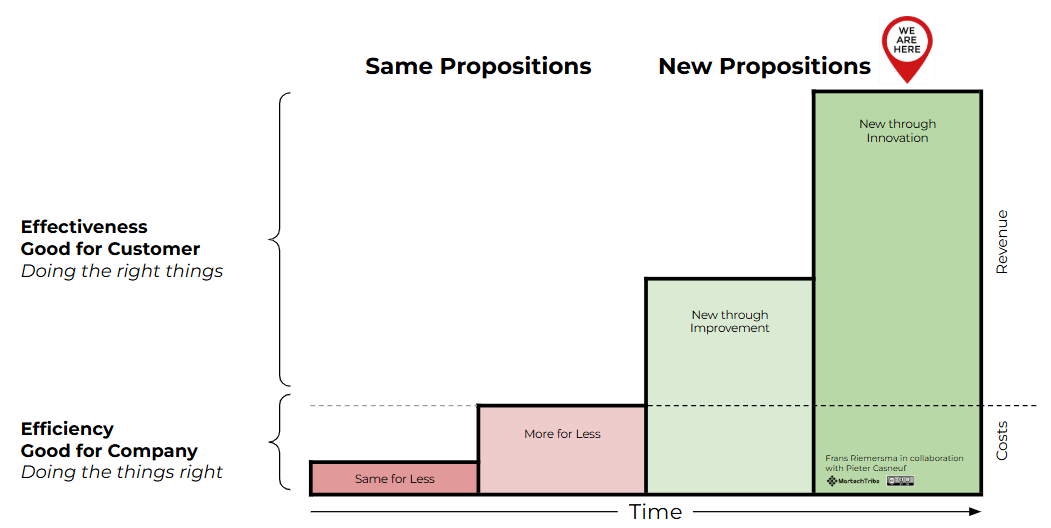
Today, most uses of Agentic AI still sit in efficiency: we are making the horse faster. But the real breakthrough comes when AI becomes part of the service itself — when agencies and service firms use AI not to optimize workflows but to transform the outcomes they deliver.
Just as the horseless carriage birthed entirely new industries, AI will create entirely new categories of value once organizations shift from efficiency to effectiveness. The leap happens when companies stop asking, “How can AI help us do this faster?” and start asking, “What new value becomes possible because AI exists?” And that shift—from efficiency to effectiveness—is exactly what positions agencies for their next era of growth.
Scaling Expertise with AI
For decades, agencies grew by adding people. More clients meant more designers, strategists, analysts, copywriters, or consultants. Capacity was always linear because the value depended on human execution. AI breaks that dependency by letting agencies scale through encoded expertise rather than additional headcount.
When an agency captures its domain knowledge — its methods, frameworks, playbooks, heuristics, and judgment — inside an AI system, it separates value from labor. Experts no longer repeat the same process for each client; they design the system that performs it. AI executes the work with the same reasoning the experts would use, but with perfect consistency and limitless capacity.
This is the moment where AI shifts from improving productivity to becoming part of the service itself. Instead of making the procedure more efficient, AI improves the outcome — delivering better, more consistent results for the customer. Efficiency helps the company. Effectiveness helps the customer. And effectiveness is where net new value is created.
Imagine a marketing agency whose brand audits are powered by an AI trained on hundreds of past engagements. Or a legal consultancy whose contract review system produces expert-level analysis instantly. These aren’t dashboards or copilots. They are expertise engines — encoded judgment delivered at scale.
Once expertise becomes software, the economics change fundamentally. Agencies can shift from billing hours to billing outcomes or subscriptions. Their margins begin to resemble SaaS rather than services, because the core input — expertise — can now be delivered infinitely without requiring additional labor.
This is the real breakthrough: a service becomes a product, a process becomes a platform, and expertise becomes an asset that earns while you sleep. Agencies that adopt this model aren’t just using AI to speed up delivery. They are redefining what they deliver. They are crossing the line from service provider to scalable intelligence business.
The firms that win will be those that learn to bottle what makes them special — and teach AI to scale it.
Who Will Move First?
Every transformation begins with a choice. The technology is ready. The economics are clear. The frameworks are in place. The only question left is who moves first.
Will agencies reinvent themselves as AI platforms, bottling their expertise into products that scale? Or will SaaS companies move downstream, using AI to offer complete, outcome-based services? Both paths lead to the same destination: the rise of the Service-as-a-Software economy.
- For agencies, this isn’t a theoretical shift. It’s a commercial one. The firms that start codifying their know-how today will own the IP tomorrow. They’ll stop selling time and start selling trust, delivered through systems that get better with every use. Their value will compound, not deplete.
- For SaaS players, the path runs in reverse. After years of selling tools, they can now deliver results based on best practices from their customer base. AI lets them close the loop—automating not just the workflow, but the work itself. A CRM that nurtures leads autonomously. An analytics platform that advises instead of reports. The line between product and service blurs until it disappears.
The next wave of growth won’t come from faster software or cheaper labor. It will come from new economies built on scalable expertise.
If you lead a service business, map where you sit on the AI Value Framework. Identify one area where your expertise repeats, then build an AI system that performs it autonomously. That’s your first step into Service-as-a-Software.
Those who act now won’t just adapt to AI; they’ll define what business looks like in its next era. AI doesn’t just let services scale like software. It lets them redefine what business can be.

Related posts
Keep reading for more marketing technology information!
How AI Changes Composability
There Is No Best-In-Class Technology. It’s Official.
Service-as-a-Software: Scale Services Like Software with AI