
Most marketers already have AI in their stack, whether they planned for it or not. In our AI and Data in Marketing study, 90.3 % of participants reported using AI agents within their martech ecosystems. Sometimes it is experimental. Sometimes it runs in limited production. Either way, the shift is happening faster than most teams expected.
To understand how these agentic capabilities are reshaping Martech SaaS, we did what we always do. We collected and clicked as many logos as we could find in the short term. The result is a snapshot from December 2025.
It is not a final map. It cannot be. AI is moving at roughly twice the speed of the internet, which means any chart freezes only a moment in time. What follows is meant to illustrate patterns, not declare conclusions or definitive mappings of tools. Martech is in flux. Constantly. So what helps you is the framework these martech tools operate in.
AI is not replacing SaaS; "SaaS using AI" is
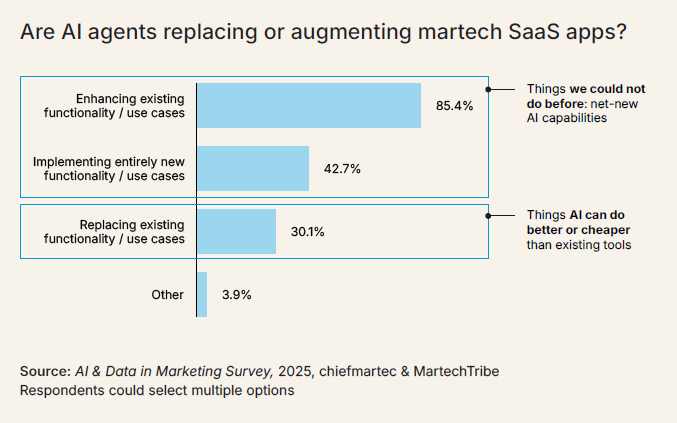
Based on our data, it is clear that AI is augmenting SaaS, not replacing it. Only 30.1% of participants say AI has replaced an existing use case. These are usually areas where deterministic SaaS tooling has been struggling. The more interesting signals sit elsewhere. A full 42.7% are implementing entirely new functionality. An even larger 85.4% are enhancing what they already have. This is expansion, not erosion or cannibalization.
The market is blending traditional SaaS with probabilistic AI in ways that feel both familiar and new. Vendors are stretching across categories. Teams are discovering use cases that were impossible only a year ago. The noise is high, so it helps to return to what the data actually shows.
The blending of AI and SaaS makes total sense. The blend of Martech and AI is a sign of the market leveraging the strength of both technologies. In fact, the two technologies are different ends of the same spectrum.
- SaaS = deterministic foundation
- AI = probabilistic use cases
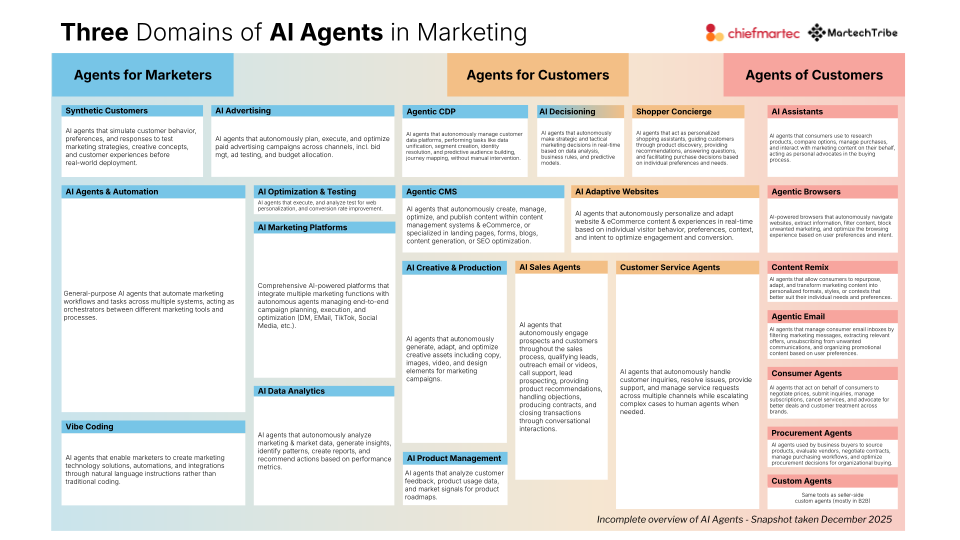
Three Domains of AI Agents in Martech
You can slice agentic AI by model type, reasoning depth, or latency. That is useful for architects, but less helpful for people who run a Martech stack. Practically, agents are tools that serve people, so the more important question is simple. Who does the agent work for, and who benefits from its actions?
Along that line, you see three domains.
- Agents for Marketers - Agents for marketers live behind the scenes. Marketers control them, configure them, and decide where they operate. They plug into workflows, crunch data, and orchestrate tasks, but customers never speak to them directly.
- Agents for Customers - Agents for customers are deployed by marketers but chosen by customers. The customer decides if and how to engage with them. They show up in websites, apps, and service channels and become part of the visible customer experience.
- Agents of Customers - Agents of customers are the big shift. These are agents customers bring with them. They act on the customer’s behalf, outside the marketer’s control. Visibility drops, power shifts, and the buyer’s journey starts to be intermediated by software that is loyal to the user, not the brand.

What Changes Inside The Landscape
When plotting the logos of vendors across these domains, we noticed that some Supergraphic Martech categories looked familiar, and some were new, or even totally new, especially in Agents of Customers.
The first group feels familiar because they extend categories that already existed in the landscape; they are classic boxes, now with agents inside.
- Customer Service Agents: AI that handles inquiries, resolves issues, and escalates only when human help is needed.
- AI Sales Agents: AI that engages prospects, qualifies leads, supports sales conversations, and helps close deals.
- AI Marketing Platforms: AI-powered systems that plan, execute, and optimize multichannel marketing campaigns.
- AI Creative and Production: AI that generates and adapts creative assets like copy, images, and video for marketing.
- AI Data Analytics: AI that analyzes marketing and market data, finds patterns, and recommends actions.
- AI Advertising: AI that plans, runs, tests, and optimizes paid advertising across channels.
- Agentic CMS: AI that creates, manages, and optimizes website and e-commerce content.
- Agentic CDP: AI that manages customer data, segmentation, identity resolution, and journey mapping.
- AI Product Management: AI that analyzes product usage, customer feedback, and signals to guide product decisions.
- AI Optimization and Testing: AI that runs and interprets tests to improve personalization and conversion.
The second group of AI Agents is new shapes inside Martech. They still sit mostly within the marketer’s world, but they create capabilities that did not exist as neat SaaS functions before.
- AI Adaptive Websites: AI that personalizes and adapts site content in real time based on visitor behavior and context.
- Shopper Concierges: AI that guides product discovery, answers questions, and assists purchase decisions.
- AI Agents and Automation: AI that automates marketing tasks across systems and acts as an orchestrator of workflows.
- Vibe Coding: AI that lets marketers build tech solutions and automations using natural language instead of code.
- Synthetic Customers: AI that simulates customer behavior to test ideas before real-world deployment.
- AI Decisioning: AI that makes strategic and tactical marketing decisions in real time based on data and rules.
This last group is a totally new spectrum: Agents Of Customers. These agents sit on the customer side of the glass, not inside the Martech stack. They are the clearest sign that AI is not only changing what Martech vendors can build, but also who controls the experience along the buyer’s journey.
- Agentic Browsers: AI browsers that navigate websites, extract information, filter content, and optimize the user’s experience.
- AI Assistants: AI that helps consumers research products, compare options, and make buying decisions.
- Agentic Email Clients: AI that manages inboxes, filters messages, extracts insights, and unsubscribes on the user’s behalf.
- Consumer Agents: AI that negotiates, compares offers, submits inquiries, and advocates for the consumer across brands.
- Procurement Agents: AI that helps buyers source vendors, evaluate proposals, and optimize purchase decisions.
- Content Remix: AI that lets consumers repurpose marketing content into formats that fit their preferences.
- Custom Agents: AI agents tailored by users or businesses for their own specific tasks or workflows.
All Definitions in One Overview


Related posts
Keep reading for more marketing technology information!
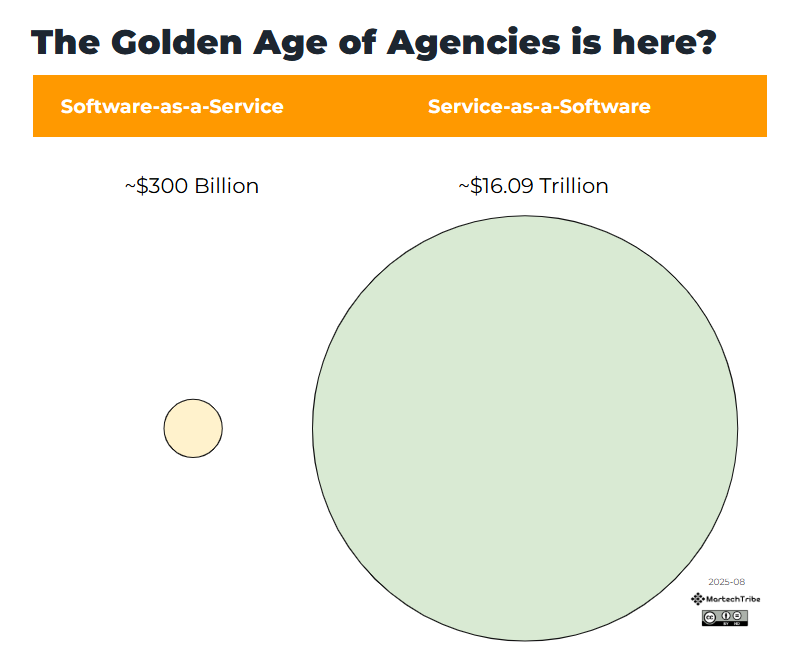
Service-as-a-Software: Scale Services Like Software with AI
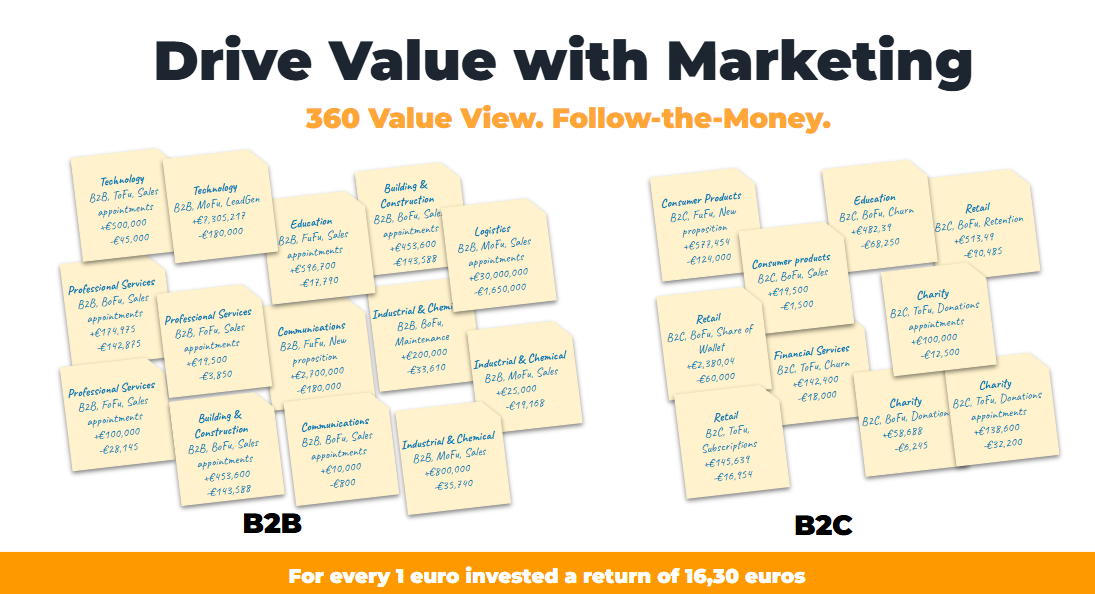
Value Engineering 101. Why, What, and How?
The Real Value of AI: From Faster Horses to New Economies