

90.3 % of companies report using AI agents within their martech ecosystem. AI is clearly reshaping Martech stacks, but not in the way many predicted. Our data shows that clearly. Only 30.1 % of marketers say AI has replaced an existing SaaS use case. Far more report the opposite. A full 42.7 % are adding entirely new capabilities, and 85.4 % are improving what they already have. AI is not consuming Martech. It is expanding it.
This expansion comes from how deterministic software and probabilistic AI complement each other. SaaS provides structure, rules, and reliability. AI brings reasoning, adaptation, and generation. One handles precision. The other handles complexity. Together, they create systems that can follow defined workflows yet adapt to changing inputs. The result is not replacement but reinforcement.
As these two forces blend, AI begins to appear inside products in recognizable patterns. It does not show up everywhere in the same way. Sometimes AI enhances a single module. Sometimes it acts across the suite. Sometimes users build agents of their own. These are not maturity levels. They are different shapes of AI infusion.
To describe these patterns, we use a simple framework of three degrees.
- SaaS + AI Modules
- SaaS + AI Agents
- SaaS + AI Agent Builders
Each degree reflects how the AI behaves, where it operates, and how much autonomy it has inside the product. Understanding these degrees provides a clearer view of what AI is actually doing inside SaaS and why Martech feels like it is stretching rather than shrinking.
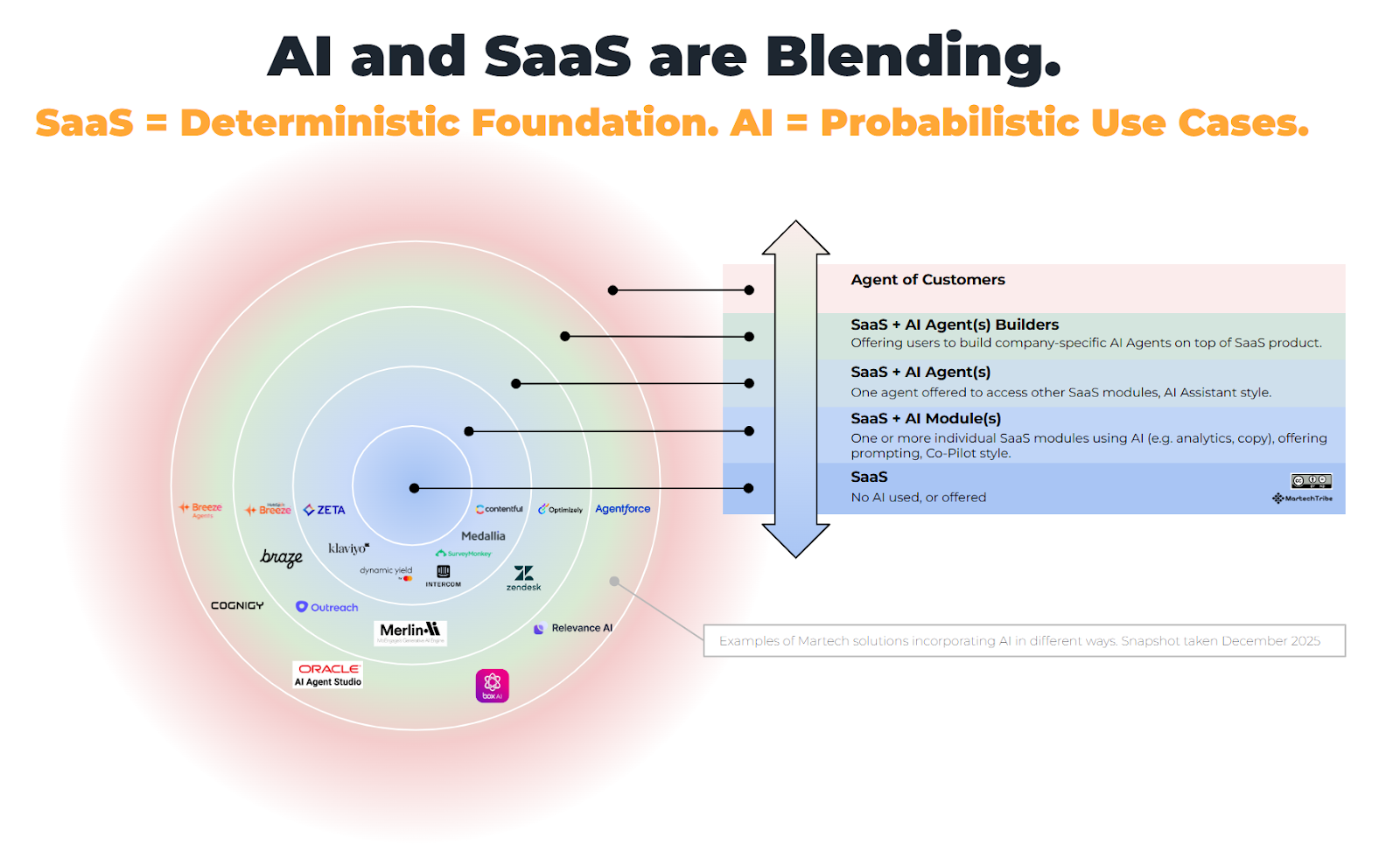
Degrees give us a shared view on AI used in SaaS
AI is showing up across Martech in many different forms. In 2024, another 2,324 GenAI native tools entered the landscape, and the pace has not slowed. Both new entrants and long-established platforms are infusing AI into their products, but they are doing it in different ways.
Some products embed AI inside a single module. Others introduce an agent that can work across several modules. A third group gives users the ability to design agents of their own. These are distinct architectural choices, each shaped by how teams expect AI to participate in everyday work. A single platform may use one degree or combine several.
Degrees give us shared language. They make it easier to describe what type of AI is present, how it behaves, and where it operates inside the product. Instead of treating AI as a single concept, the degrees highlight the different shapes it takes and the different roles it can play.
The purpose is not to measure tools. It is to understand how AI and SaaS fuse. As AI continues to expand inside Martech, these degrees help clarify how the technology is woven into the stack and what kinds of capabilities emerge at each stage. They help frame the conversation in structural terms rather than in marketing claims.
Degree 1: SaaS + AI Modules
AI modules are the most common way AI appears inside Martech platforms. In this degree, AI is added to individual parts of a product, such as analytics or dashboards inside a platform suite. The AI stays inside that module and enhances tasks within that specific area. It remains local, which means it does not operate across the rest of the suite.
What defines this degree
- What AI does: Enhances a single module with generative or predictive features.
- Scope of action: Within the module where the AI is embedded.
- Autonomy level: Low, user-triggered, and co-pilot style.
AI modules make existing tools smarter without changing how the broader system works. They speed up tasks, reduce manual effort, and provide assistive intelligence inside the boundaries of that module. This degree answers the question of how AI can enhance an existing tool without altering the underlying architecture.
Degree 2: SaaS + AI Agents
AI agents represent the next degree of AI infusion inside SaaS platforms. Instead of enhancing a single module, the agent can move across multiple parts of the vendor’s suite. It acts as a unified interface that connects data and actions from different modules, allowing it to carry out tasks that span the product rather than staying confined to one area.
What defines this degree
- What AI does: Performs tasks and workflows across multiple modules through a vendor-provided agent.
- Scope of action: Multi-module, but contained within the vendor’s ecosystem.
- Autonomy level: Medium, with agent-driven execution inside defined boundaries.
AI agents reduce the need for users to click through modules or stitch workflows together manually. They provide a single entry point for actions that draw on several parts of the suite, increasing flow without requiring the customer to build anything themselves. This degree answers the question of how AI can coordinate work across modules while remaining rooted in the product’s existing structure.
Degree 3: SaaS + AI Agent Builders
AI agent builders represent the outer degree of AI infusion inside SaaS platforms. Instead of relying on vendor-provided agents, customers can design and deploy their own agents using the platform’s data, tools, and workflows. This shifts AI from something you use to something you create. It turns the product into an environment for defining how agents should reason, act, and move through multi-step work.
What defines this degree
- What AI does: Executes custom logic, workflows, and actions through user-built agents.
- Scope of action: Multi-module, with agent behavior shaped by the user’s design.
- Autonomy level: High, with structured, user-defined orchestration.
Agent builders give teams the ability to automate work that reflects their own processes, not just vendor-defined patterns. These agents can coordinate tasks across modules, react to triggers, use memory or context, and sometimes extend beyond the suite through integrations. This degree answers the question of how AI can run parts of the business on behalf of the user, using agents tailored to how that organization works.
What These Degrees Reveal
AI infusion is structural, not cosmetic. It changes how SaaS works at its core. It reshapes where intelligence lives and how workflows run.
The shift is architectural.
- First, AI improves tasks.
- Then it connects modules.
- Finally, it extends across ecosystems.
Each degree comes with a different kind of capability. A different scope of action. A different role the AI can play inside the stack.
This framework gives marketers language for what is actually happening. It separates patterns from noise. It shows how AI enters SaaS and how those choices shape what the platform can do over time.

Related posts
Keep reading for more marketing technology information!
Service-as-a-Software: Scale Services Like Software with AI
Value Engineering 101. Why, What, and How?
The Real Value of AI: From Faster Horses to New Economies